


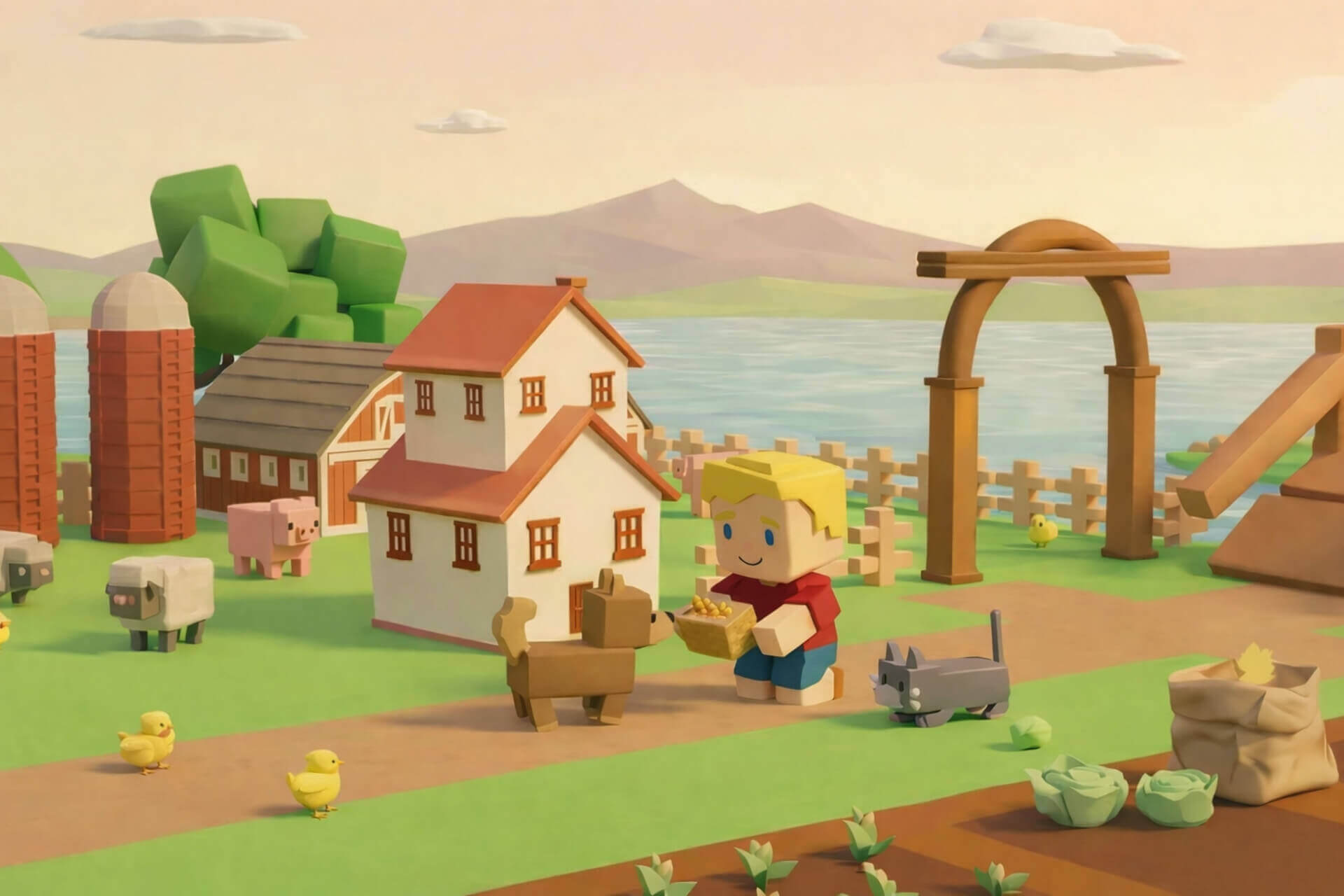
Wavering Terrarium: what we built with AI, and what it couldn't decide
A browser game for the nitrogen problem "Wavering Terrarium"
Insights from Loftwork’s creation process
It takes more than being right to move people.
Society recognizes climate change, food security, resource circulation, and biodiversity as urgent issues, yet struggles to connect them to daily life. The nitrogen problem belongs to this same category.
The Research Institute for Humanity and Nature’s Sustai-N-able Project and Loftwork have worked together on this problem across several projects. They produced a video that used systems thinking to map the structure of the issue. They co-created the exhibition “Sense of the Unseen: Ghost Stories and Nitrogen” with artists. They ran a requirements-definition workshop for an app that measures nitrogen footprints. Every project pointed to the same gap. Public awareness of the nitrogen problem remains low. Before people will act or engage, the team first has to make the issue matter to them.
To bridge this gap, the team developed a browser game, Wavering Terrarium — N and Our World.
Hiromi Ouchi, a project manager and technical director at Loftwork, led the project. Hiromi built the game’s prototype herself using AI coding tools, then refined the experience within a short production window by incorporating feedback from Skeleton Crew Studio, a game development company.
The goal wasn’t just to explain the nitrogen problem. It was to make a browser game. One where players could feel for themselves how their own choices reshape the world. What did Hiromi try along the way? Where did she hesitate? What did she decide? Drawing on an interview with Hiromi, this article considers what “making” means in the age of AI.
Who we talked to

Technical director at Loftwork. Driven by an interest in DAOs (Decentralized Autonomous Organizations) and digital public goods, Hiromi spent her student years attending conferences and hackathons worldwide to explore where technology meets society. She joined Loftwork as a new graduate in April 2025. She specializes in prototyping using generative AI and no-code tools such as Bubble.
For the project Wavering Terrarium, she served as Project Manager and Technical Director. She led prototype development with AI coding tools and managed the feedback loop alongside game creators.
Turning the nitrogen problem into an experience, not an explanation
Hiromi started with a basic question. Why did the nitrogen problem need to be a game at all?
While defining requirements for the nitrogen footprint app, the team hit a wall. Most people had no reason to want to measure their footprint in the first place. “We needed something to build awareness first, something that would make people see this as their own issue,” Hiromi says.
Wavering Terrarium was built as a teaser game playable in a web browser. It is not a finished product. Instead, it is season.0, a prototype that establishes the concept, the world, and the shape of the experience for a future series. Production ran for about three and a half months, from December 2025 to March 2026.
Skeleton Crew Studio joined the project as game creators alongside Loftwork. Their role was not to build with AI themselves. They played working builds of the game as it developed and gave feedback on its controls and overall experience.
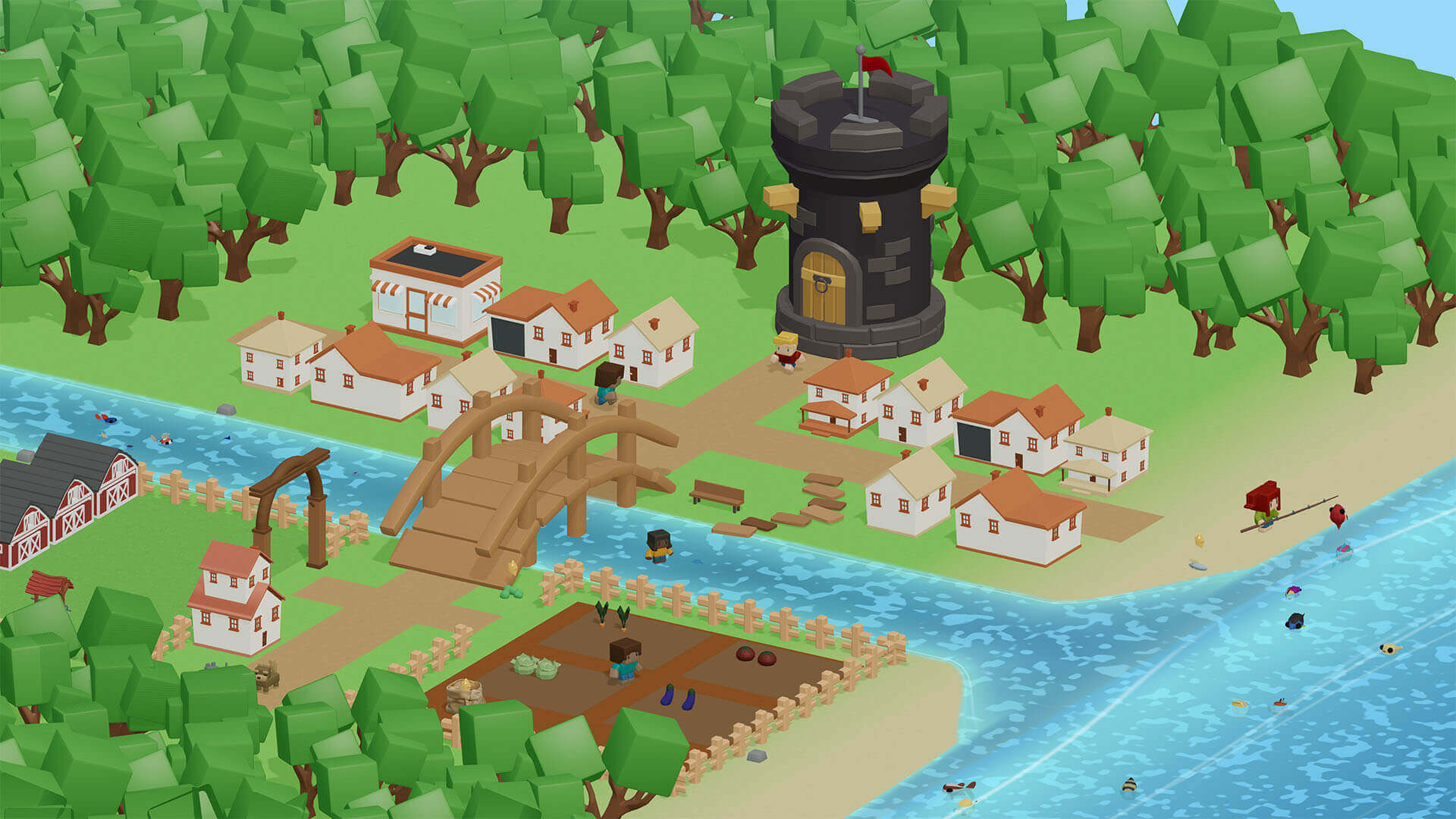
The game had two goals. First, reveal the state of human nitrogen use and its problems through feeling and experience rather than explanation. Second, use the game as a communication tool that asks players to consider sustainable ways of engaging and explores what sustainable nitrogen use could look like.
One decision mattered above the rest. The game would not explain the nitrogen problem directly.
Content about social issues tends to fall into a familiar sequence. What’s the problem? Why does it matter? What should people do about it? Accurate information is essential, of course. But stacking up correct facts doesn’t necessarily move people to care or act. Sometimes the opposite happens. The more information a piece delivers, the more it reads like homework that has nothing to do with the reader’s own life.
Multiple rounds of prototyping pointed the team toward a different approach. Instead of transmitting knowledge in one direction, they built a space where players experience the results of their own choices firsthand.
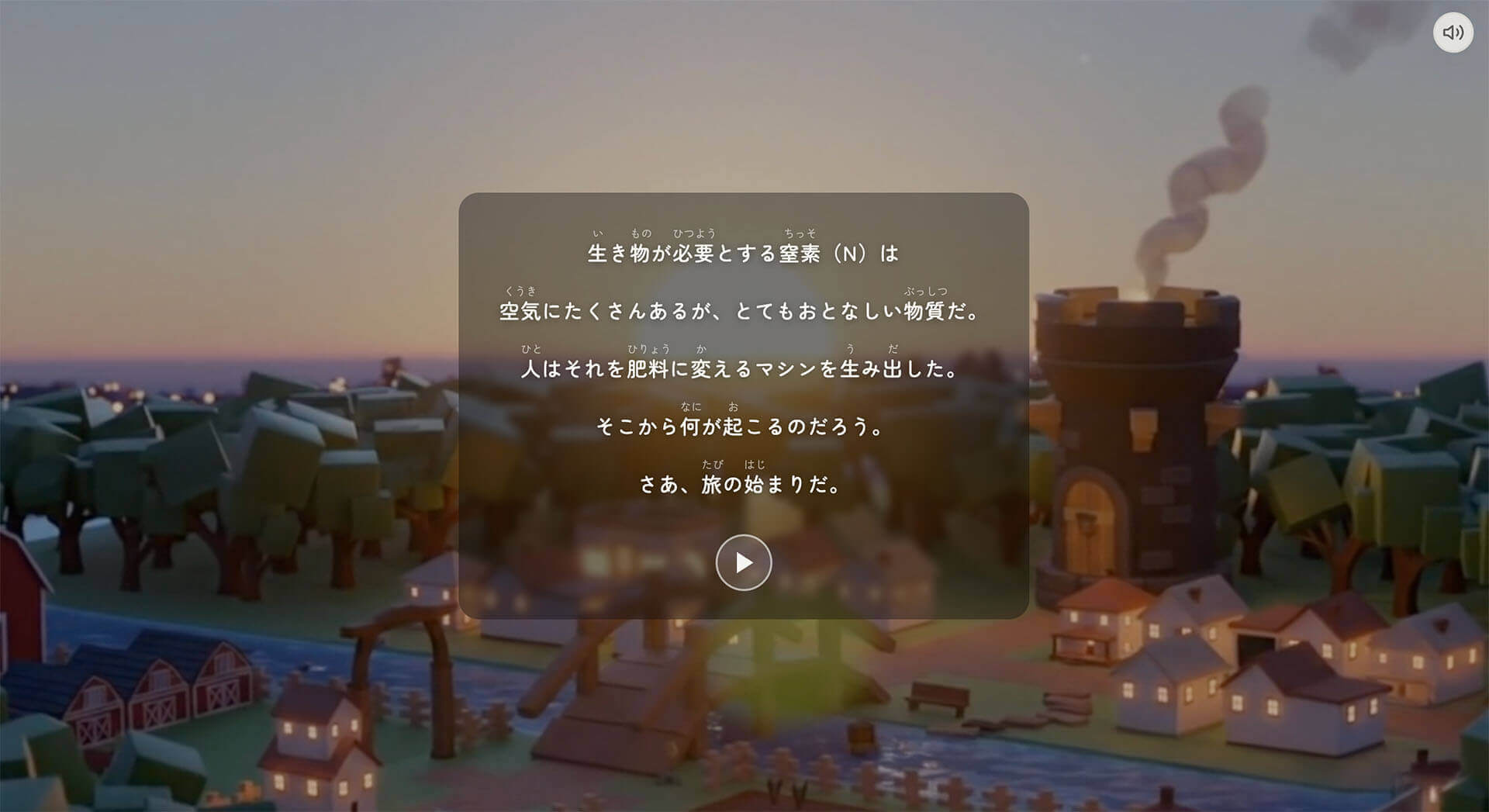
At the start of the game, players choose the output level of a nitrogen-fixing machine. Lower output keeps the environment clean but leaves food scarce. Higher output secures food but pollutes the environment.
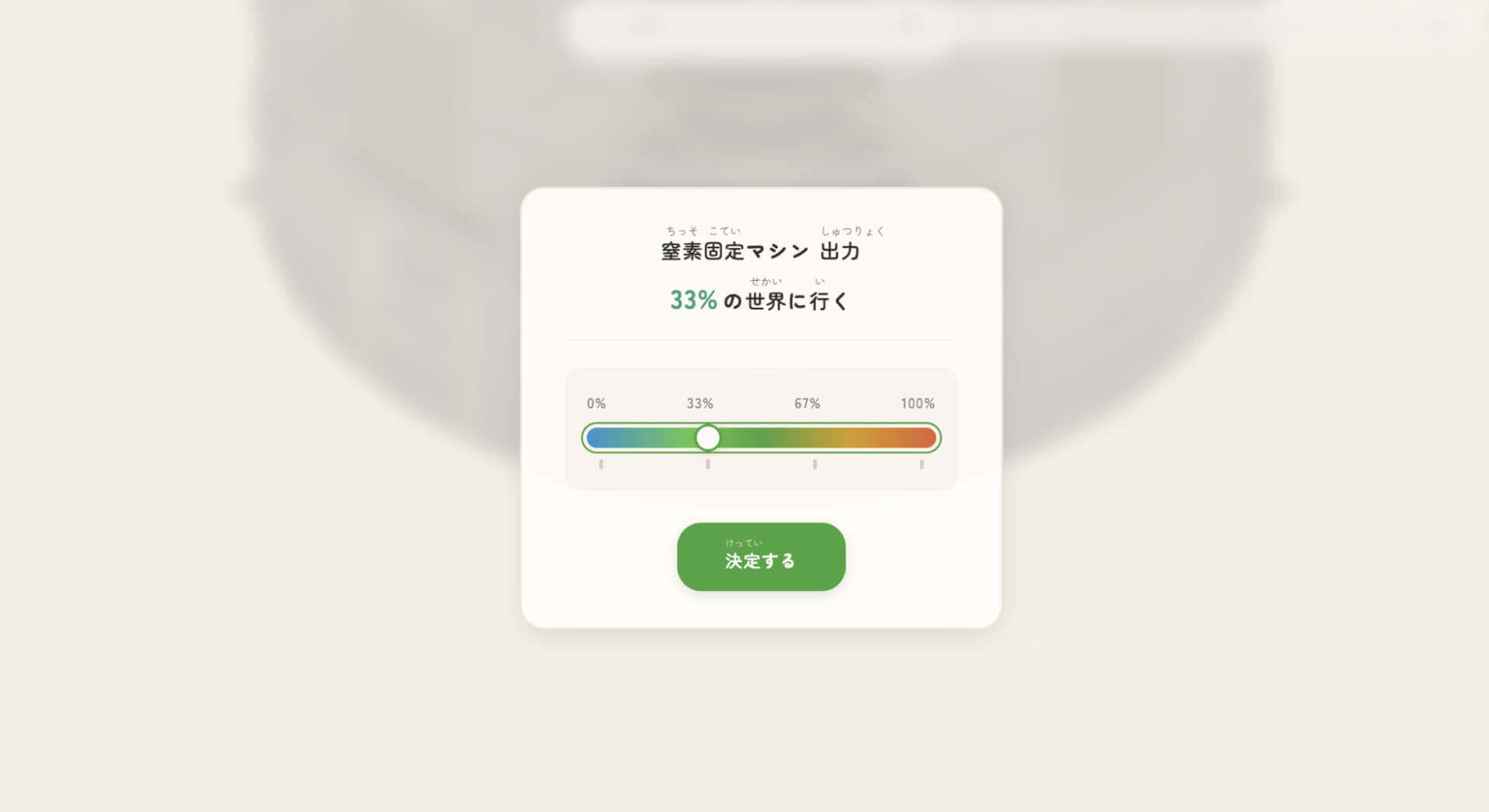
At the start of the game, players choose the output level of a nitrogen-fixing machine. Lower output keeps the environment clean but leaves food scarce. Higher output secures food but pollutes the environment.
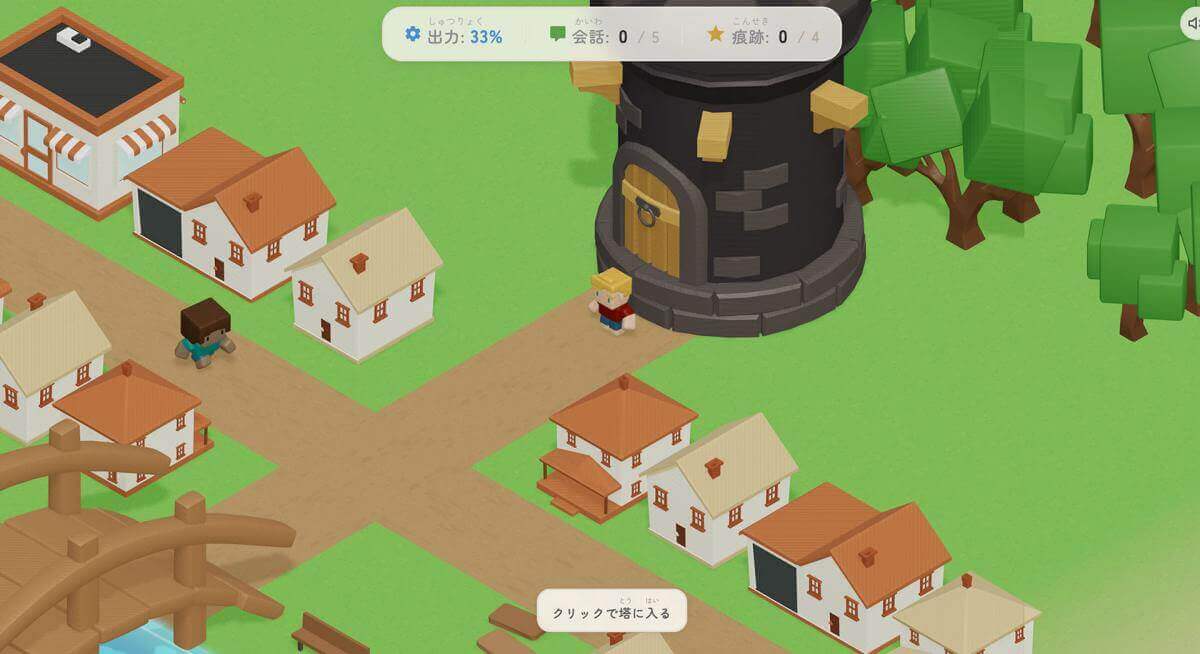
At the start of the game, players choose the output level of a nitrogen-fixing machine. Lower output keeps the environment clean but leaves food scarce. Higher output secures food but pollutes the environment.
The game offers no clear happy ending, nor any choice that satisfies everyone at once. Players aren’t asked to figure out which option is “right.” They confront a plainer reality. Choosing one thing means disturbing another. Through this design, the nitrogen problem stops being abstract knowledge. It becomes a personal stake in a world shaped by their own choices.
Testing fast with AI to pin down the heart of the experience
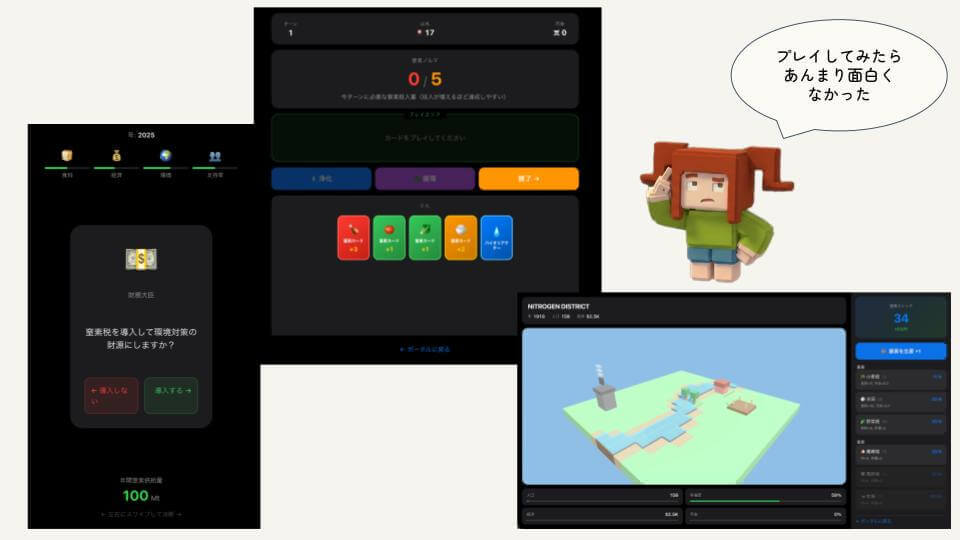
One thing set this production apart. Hiromi, the technical director, built the prototypes herself using AI coding tools. She started by building several mini-games this way. But when she actually played them, she says, “the sense of learning about the nitrogen problem was weak.”
This, perhaps, is the true essence of prototyping in the age of AI.
AI speeds up the move from idea to working prototype. Ideas that once needed too much time and budget to test now take shape in days. But speed cuts both ways. The faster something takes form, the sooner the team runs into the harder question, “Is this actually the experience we set out to deliver?”
After several rounds of prototyping, Hiromi and Skeleton Crew Studio changed direction. Rather than forcing the nitrogen problem into the game’s rules, they shifted toward an experience built around walking through town, talking to residents, and watching the world change. Between trade-offs with no correct answer, both the world and the player’s own feelings waver. That unresolved quality became the entry point for thinking about nitrogen. This shift gave rise to the prototype for what is now Wavering Terrarium.
For Hiromi, AI wasn’t a source of answers. It was a partner for surfacing what felt wrong. Build it, try it, sense that something’s off, rebuild it. By cycling through that loop quickly, she says, the outline of an experience that words alone couldn’t capture started to come into view.
Turning an AI prototype into a real game experience, together with creators
Building a working prototype with AI is one thing. Turning it into an experience that reaches people is another.
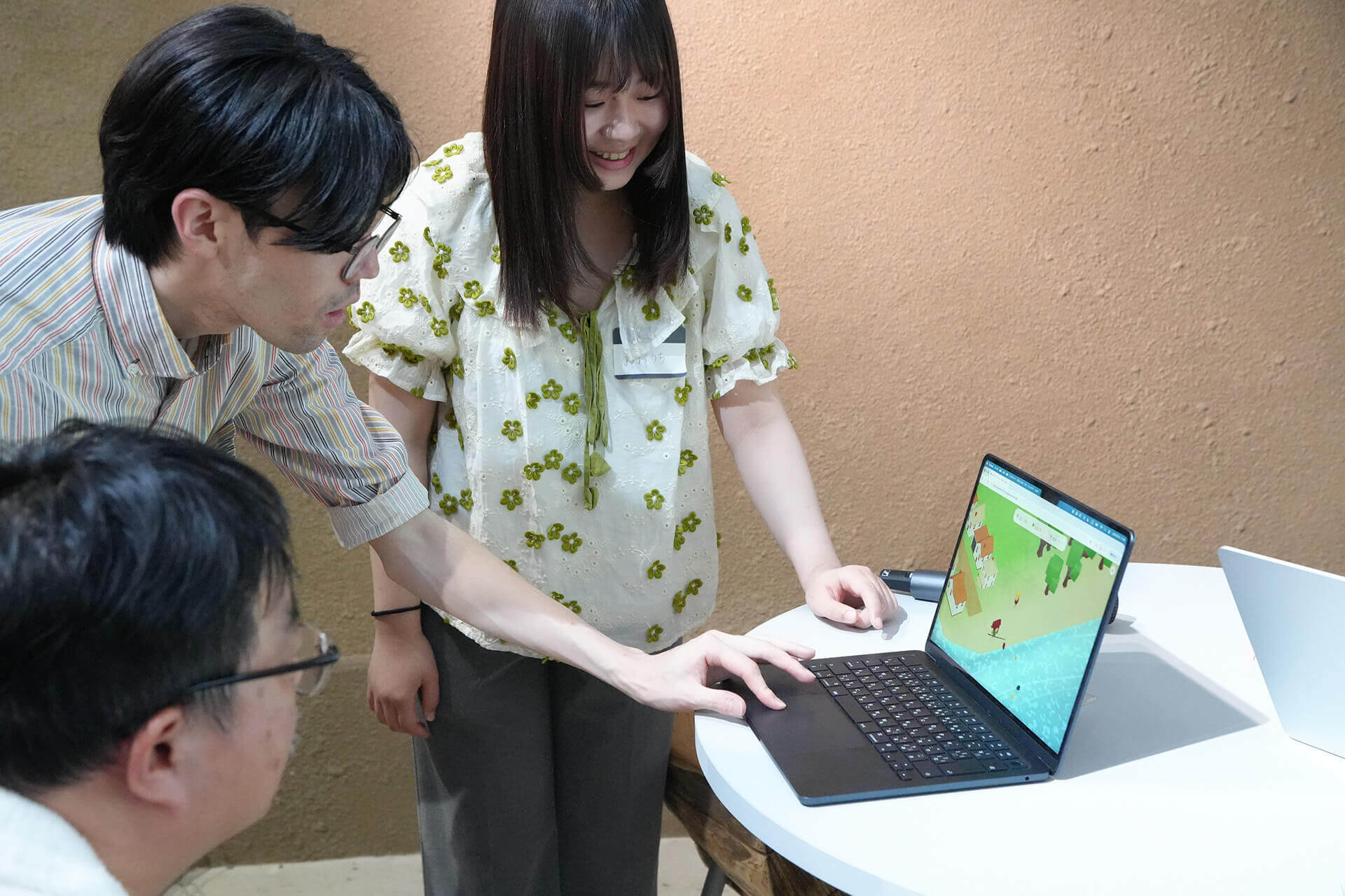
Skeleton Crew Studio’s role was to provide feedback as professional game creators. Hiromi handled development and revisions with AI. Skeleton Crew Studio playtested each build and gave feedback. They repeated this loop every week.
AI increased the speed of production. Professional judgment sharpened the precision of the experience. Loftwork stood between the two. It translated a research question into an experience that connects with the public. That was the division of labor behind this project.
Creator Comment
When we were first consulted about turning a research field into a game, we proposed an AI-driven, hackathon-style workshop, given the timeline and budget. We believed this approach could draw in a wide network of participants and gather a range of ideas.Given the nature of this particular field, we felt Hiromi succeeded in protecting the integrity of the research while capturing the researchers’ intent and the perspectives they valued most, turning it into an approachable game experience. Making the game was always a means to an end. What matters is digging deeper into the issue and broadening understanding of it. We hope this reach continues to grow.
Takeshi Ishikawa, Studio Producer, Skeleton Crew Studio
Frankly, I was surprised that Hiromi built this largely on her own, with support from Usami, a director at Loftwork, when game development usually splits across a team of specialists. It made me realize how far AI can take you. But even when AI performs well, whether its output actually serves the development goal is a separate question. When turning a social issue into a game, I think the basic requirement is a natural experience that doesn’t create friction for the player. If something feels off, players focus on that discomfort before they ever get to the issue itself. This time, we paid close attention to whether a natural experience, from the title through the input device, the UI, NPC movement, and sound, could draw people into caring about the nitrogen problem. What impressed me wasn’t the AI. It was Hiromi, who understood my intent and used AI as a tool to carry it out. Deciding what to deliver to the user is, and I think will remain, a creator’s job.
Munehiko Yasunami, Studio Manager, Skeleton Crew Studio
AI doesn't remove decisions. It multiplies them
For Hiromi, AI was never something that “made things automatically.” It was closer to a partner, one that turned a thought into form quickly and surfaced what felt wrong.
AI has lowered the barrier to making things. But this project revealed a different lesson. AI doesn’t take decision-making off a person’s hands. Where does academic accuracy end and simplification begin? How do you translate a trade-off into something players experience? What gets delegated to AI, and where does a human judgment call need to step in? These questions came up again and again during production.
Hiromi documented every design decision and organized the town’s coordinates, roads, buildings, and collision detection to create an environment where she could work well alongside AI. AI implemented the terrain and logic. She combined that with 3D assets, image-generation AI, and royalty-free sound. Working within a limited set of conditions, she built the experience by constantly judging what to hand to AI and what to decide herself.
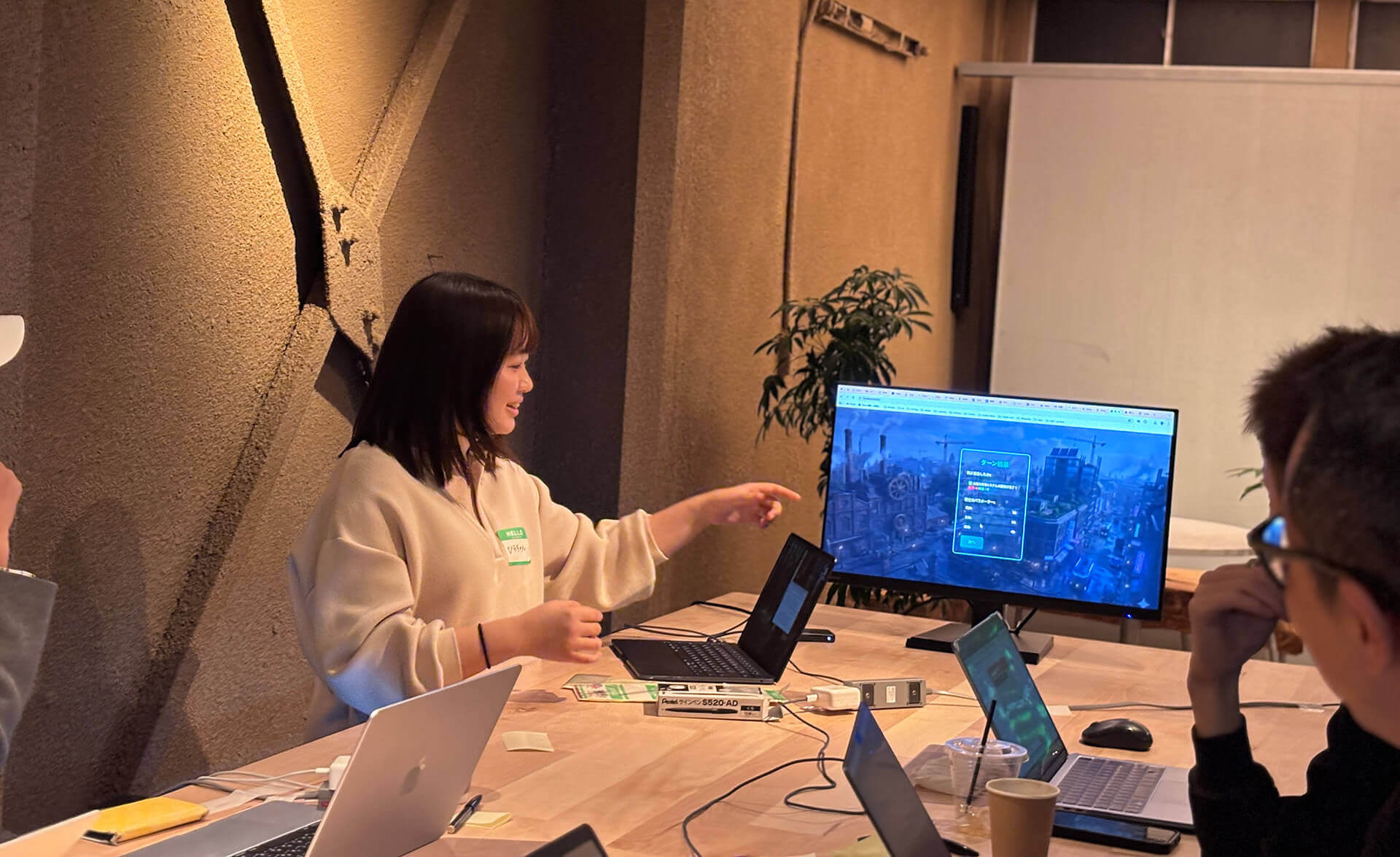
This is not simply a story about making something with AI. Behind this project was a person who built the structure, put judgment calls into words, and kept weighing what to keep and what to cut against the project’s purpose.
Hiromi highlights deciding for yourself as her biggest takeaway from this project. In the age of AI, “making” isn’t about avoiding decisions. As possibilities multiply, it’s about constantly defining what truly matters to the team.
Giving tangible form to an open question
AI now lets people generate countless patterns quickly. That shift moves the maker’s real job toward deciding. What gets cut, and what intent survives the cut? Make it a game about walking through town. Build a mechanic where the world itself wavers. Never hand players a correct answer. Wavering Terrarium is a stack of decisions like these, each one made on purpose. The faster AI lets a team build, the more judgment calls that speed demands.
The team didn’t build Wavering Terrarium only to succeed as polished entertainment. The game exists to open a research field to conversation with more people. That took more than skill at building games. The team had to understand the questions researchers were asking, and decide what to carve out as an experience without flattening the complexity of the nitrogen problem. They had to build hypotheses quickly with AI, then sharpen the experience by drawing on a game creator’s expertise. And they had to carry all of that forward as a single project.
This is where Loftwork’s version of “making” sets itself apart.
Loftwork weaves together research, creative work, technology, and points of contact with society. That combination turns a question that hasn’t taken shape yet into an experience other people can join. AI becomes a powerful tool in that process, but a tool alone doesn’t finish a project. It takes a person to frame the question, connect the people involved, and edit all of it into something that works as an experience. Only then does it reach society. Being right alone doesn’t reach people. That doesn’t mean letting go of being right. It means building fast with AI while a person keeps holding onto the question.
“Making” in the age of AI isn’t only about efficiency. It’s about taking what being right alone can’t communicate and giving it a shape someone can actually touch. That shape starts a new conversation. Wavering Terrarium is one attempt at doing exactly that.
Play the game
Written by Mai Miyazaki (Loftwork)
Recommended
-


2026.06.09
What do humans still do the best in the age of AI: An interview with Loftwork's MTRL Tokyo team
-

2026.06.05
At ComoNe, curiosity finds company inside a co-creation space at Nagoya University
-

2026.04.22
Beyond the award: How Loftwork uses open calls to transform how companies innovate
-
2026.02.17
The ripple effect of MVMNT Behind the scenes of the [UN]REAL ESTATE exhibition at MAB25, Bangkok
-

2026.02.06
What happens when vacant spaces are unlocked? The people and stories weaving the connections behind FUJI TEXTILE WEEK
-


2025.12.02
AI is not magic: FabCafe’s ongoing quest to define our relationship with technology